


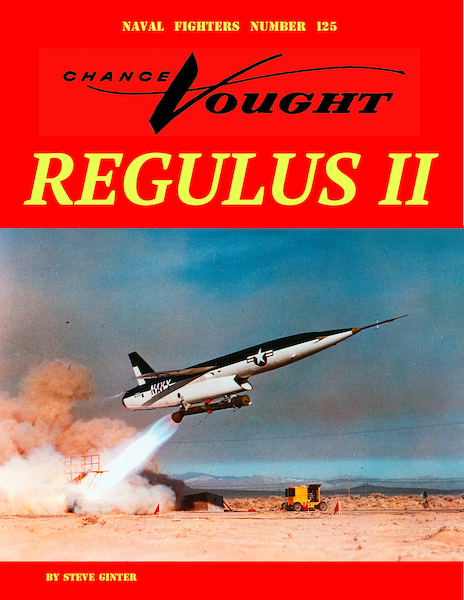

Description
Volume 125 of the Naval Fighters series. At a time when most fighter planes were subsonic and only a few could reach supersonic speeds, Chance Vought was tasked with building a submarine-launched cruise missile equipped with nuclear weapons. The result was a craft so fast that even the Navy’s fastest fighter aircraft (also built by Vought), the F8U Crusader, could not keep up with it. The attack was carried out either from high altitude or on deck with a pitch-up and a subsequent vertical final approach at a speed of over 1,000 mph. The W27 nuclear warhead could be deployed with maximum precision thanks to the internal navigation system (INS) developed by Vought. The Regulus II program was extremely costly, involving three specially built submarines, two diesel and one nuclear. At the same time, the Navy was developing a submarine-launched intercontinental ballistic missile (ICBM), Polaris, a program that was even more expensive and technically challenging than Regulus II. Although Regulus II was only a year away from operational readiness, the Navy canceled the program in December 1958 and focused on Polaris. Twenty-seven Regulus IIs had been completed. The 21 remaining partial designs were completed between 1960 and 1962 as K2DU-1 target drones. The drones were used by the Air Force from 1959 to 1962 as targets for the Bomarc surface-to-air missile. The Navy used them from 1959 to 1965 as targets for air-to-air and surface-to-air missiles.


